
Residential · New Hampshire & Massachusetts
Water Damage Claims in New England
Water is the most common home loss in New England — and one of the easiest for a carrier to underpay. We document what the water actually reached, not just what shows on the surface.
What this loss really involves
Water Damage, in plain English.
Water damage rarely stops where you can see it. A burst supply line, a failed water heater, an ice-dam backup, or an overflowing appliance sends water down through wall cavities, under flooring, and into the framing — where it keeps causing damage long after the floor looks dry.
The losses a homeowner misses on their own are almost always the hidden ones: saturated insulation inside the walls, subfloor and sill-plate rot, warped hardwood that hasn't cupped yet, and the mold that starts within 24–48 hours in wet drywall and cavities. There are also code-driven costs — when you open a wall in an older New England home, current building code often requires upgrades the original construction didn't have.
A proper claim accounts for the full drying and rebuild: demolition of unsalvageable materials, professional structural drying, and reconstruction back to pre-loss condition — not a coat of paint over a wall that's still wet behind it.
Where carriers underpay
How insurers underpay a water damage claim.
Carriers underpay water claims in a few predictable ways. The most common is scoping only the visible damage — the stained ceiling, the buckled floorboards — while ignoring the moisture that traveled inside the assembly. If it isn't documented with moisture readings and photos while it's wet, it's easy for the insurer to leave it out.
Others include lowballing the drying equipment and duration, denying matching (replacing only the damaged flooring so your kitchen ends up two-tone), disputing whether the loss was "sudden and accidental" versus long-term seepage, and quietly omitting the code-upgrade costs your policy's ordinance-or-law coverage is supposed to pay.
Every one of these is a documentation fight. The homeowner who accepts the first estimate usually leaves real money — and a properly dried, properly rebuilt home — on the table.
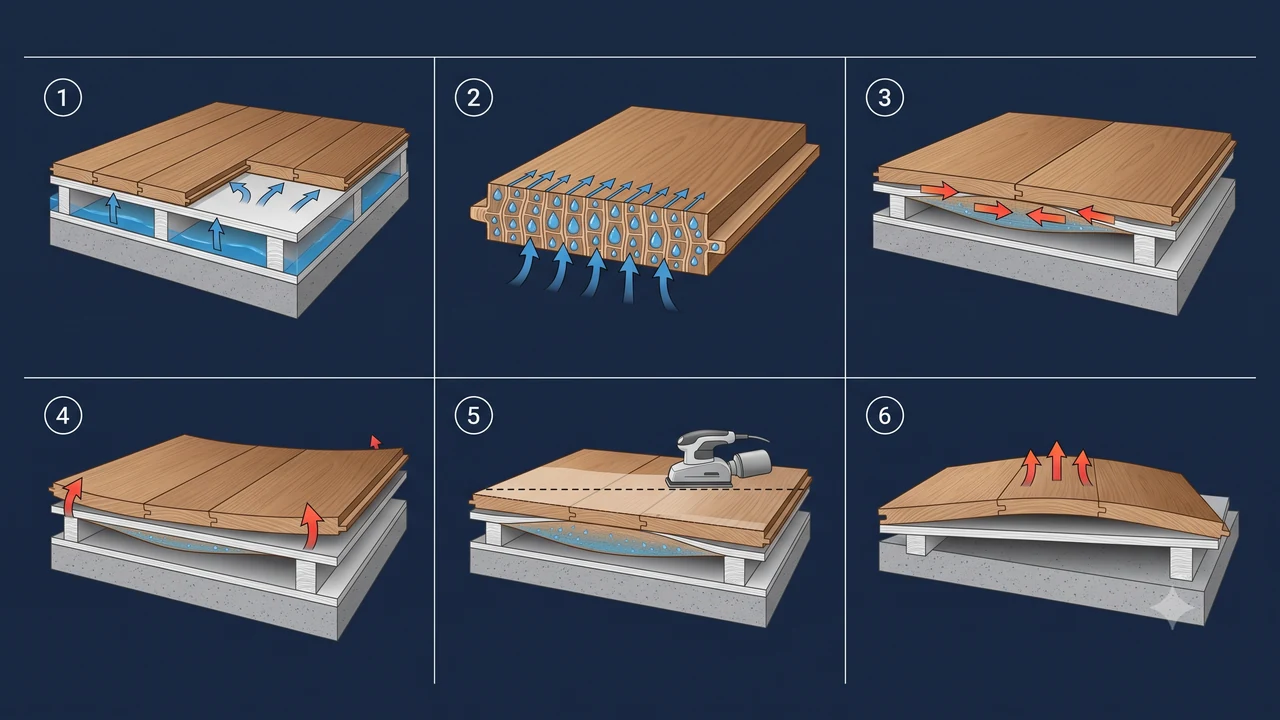
What water really does to a hardwood floor
Water damage to a hardwood floor is rarely just the surface you can see. Moisture wicks up from the subfloor into the boards, and as the wood absorbs and releases it the planks cup, lift, and — if they are sanded too soon — crown. That is why a proper repair is so often a full replacement, not the refinish a carrier wants to pay for.
- 1Trapped Subfloor Moisture. Water saturates the subfloor and slab, and moisture rises into the underside of the boards.
- 2Wood Cells Saturated. Capillary action draws moisture up through the wood, saturating the cells from the bottom up.
- 3Lateral Expansion. Swollen boards expand and press against each other, building compression stress along the seams.
- 4Cupping. Unequal swelling forces the edges up and the centers down, creating a concave "U" across each board.
- 5Premature Sanding. Sanding a cupped board flat while it's still wet levels the top but grinds material off the raised edges — the wood underneath is still swollen and wet.
- 6Crowning. As the wood dries and the swelling reverses, the sanded-down edges drop and the center rises — a crowned, permanently deformed board bowed the opposite way. This is why a wet floor needs full drydown before assessment, and full replacement once cupping is set — not a sand-and-refinish.
How SPA handles it
What we do differently.
We inspect before anything gets torn out or dried, and we document the loss the way the policy actually reads: moisture mapping, thermal imaging where it helps, and a photographed record of every affected material. That evidence is what turns "we think it went into the wall" into a line item the carrier has to pay.
We build a detailed scope and estimate covering demolition, structural drying, reconstruction, and any triggered code upgrades, and we handle the back-and-forth with the adjuster directly. If the carrier disputes cause or scope, we're the ones making the case — with the file to back it up — so you're not arguing hydrology with an insurance company while your house is torn open.
The New England angle
New England water losses have a winter signature — frozen and burst pipes, and ice dams that force melt-water up under shingles and down interior walls. We see these every year and know exactly where that water goes and how carriers try to carve it up.
Water is the loss we handle most, and the one where an experienced public adjuster most often changes the outcome. If your home has taken on water — from a pipe, an appliance, a roof, or an ice dam — the most valuable thing you can do is get it documented correctly before it’s dried out or demolished. That’s a call worth making early, and it’s free.
Related
Other losses we handle.
Have a water damage loss? Let’s talk — it’s free.
Get a free, no-obligation claim review. Tell us what happened and we’ll tell you where you stand — honestly.
No up-front fees. We only get paid when you do.