
Residential · New Hampshire & Massachusetts
Mold Damage Claims in New England
Mold is rarely the first loss — it's the aftermath of water that wasn't fully dried. That connection is exactly what carriers try to break.
What this loss really involves
Mold Damage, in plain English.
Mold grows where moisture lingers — behind walls after a leak, under flooring after a flood, in an attic after an ice dam. It often starts within 24 to 48 hours of a water event and spreads inside cavities where you can't see it. By the time there's a visible or smellable problem, the contamination is usually larger than it appears.
A proper mold claim covers remediation by qualified professionals, removal and replacement of contaminated materials, addressing the underlying moisture source, and restoring the affected areas — ideally handled as part of the original water loss rather than as a separate, limited claim.
Where carriers underpay
How insurers underpay a mold damage claim.
Mold is one of the most disputed items in home insurance. Many policies carry a mold sublimit — a low cap — so carriers have a strong incentive to route damage into that bucket rather than treat it as part of the covered water loss. They'll argue the mold is a separate "maintenance" problem, dispute the extent, or approve a minimal remediation that doesn't address what's inside the walls.
The key battleground is causation: if the mold is tied to a covered sudden water event and handled promptly, it's part of that claim; if it's framed as long-term neglect, it gets capped or denied.
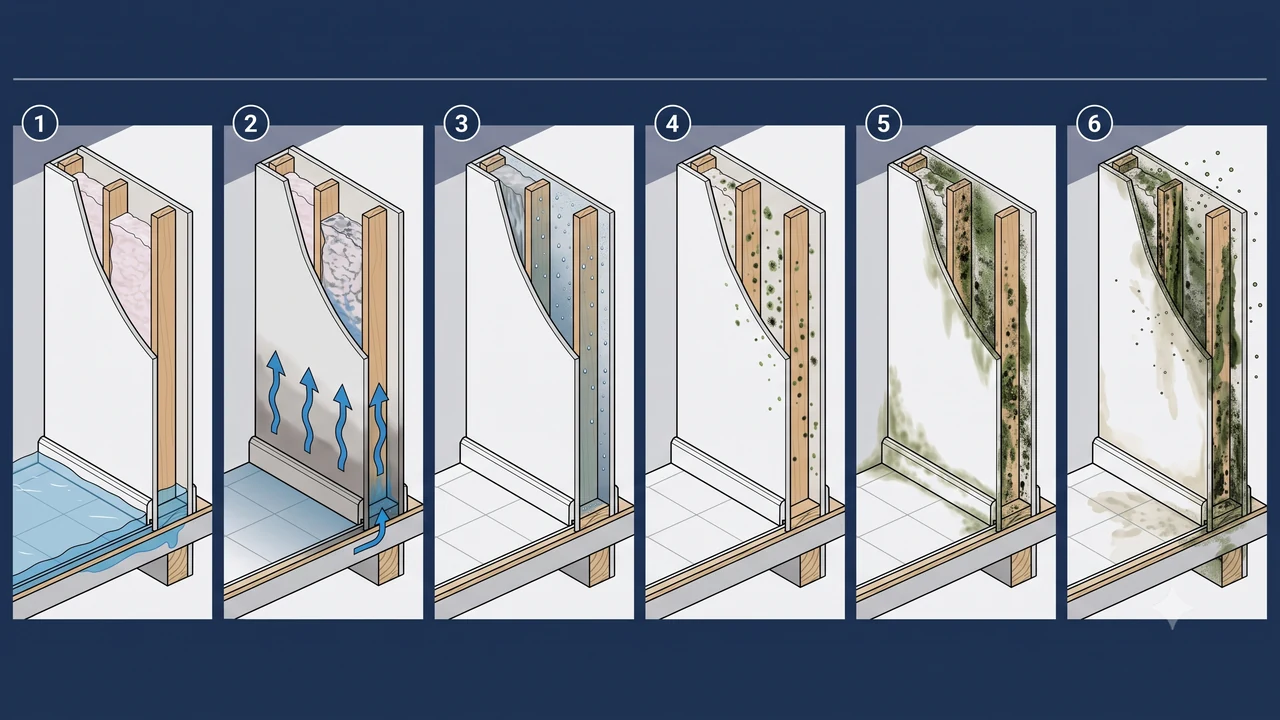
A mold problem is a water problem no one dried out
Mold is almost never the first event — it is what an untreated water loss becomes. Water left in a wall cavity wicks upward, gets trapped, and quietly colonizes the back of the drywall and framing long before anything shows on the finished wall. By the time it is visible, the contamination is already deep.
- 1Untreated Water Source. Standing water pools at the floor and baseboard and seeps into the wall cavity — the loss that never got dried out.
- 2Wicking & Absorption. Moisture wicks up the cavity into the insulation and framing, well above the visible waterline.
- 3Trapped Moisture. The closed cavity holds the damp like an incubator — saturated, but with no mold yet, so nothing shows on the surface.
- 4Hidden Colonization. Mold takes hold on the back of the drywall and the stud while the finished wall still looks clean.
- 5Advanced Growth. Colonies spread across the framing and bleed through onto the visible wall and baseboard.
- 6Full Contamination. Black and green growth saturates the cavity, stains the finished surfaces, and disperses spores into the room air.
How SPA handles it
What we do differently.
We connect the mold back to its covered cause and document the full extent — including what's growing inside the assembly — so it's handled as part of the water loss rather than shunted to a sublimit. We scope proper professional remediation, insist the underlying moisture source is fixed, and push back on the "maintenance" framing carriers reach for.
The New England angle
New England's freeze-thaw cycles, humid summers, and older, tighter-retrofitted homes make post-water mold common. We've seen how regional carriers use the mold sublimit — and how to keep a covered loss from being reclassified into it.
If you’ve found mold after a leak or flood, how the claim is framed matters enormously. Tied to the covered water loss it’s payable; called “maintenance” it gets capped. Get it documented and connected to the cause early.
Related
Other losses we handle.
Have a mold damage loss? Let’s talk — it’s free.
Get a free, no-obligation claim review. Tell us what happened and we’ll tell you where you stand — honestly.
No up-front fees. We only get paid when you do.